Start a project

If you would like to find out more about how we can work together, fill out the form and we’ll set up a time to chat about what’s next for your brand.


for best experience
.svg)

Ask anything. See everything.
Conntour is an AI-powered video intelligence platform that lets security operators talk to their cameras in plain language. We built a brand with the authority of a defence institution and the precision of the technology it represents — repositioning a YC Combinator startup with a brand built for powerful growth.
- Brand Strategy
- Brand Positioning
- Visual Identity
- Verbal Identity
- Brand Guidelines
- Website Design
- Website Development
- Brand Collateral
- Photography Direction

Video surveillance is a market with hundreds of players and one shared affliction: everything looks the same. Legacy incumbents sell rigid, parameter-based analytics — detect a license plate, flag a weapon, filter by shirt colour — and wrap it in the visual language of fear: dark rooms, glowing monitors, all-seeing eyes. Into this walked Conntour, a Y-Combinator startup already selling to government intelligence agencies and Fortune-tier enterprises, with technology that made seasoned security directors' jaws drop in live demos. The problem was everything surrounding the demo. The brand read seed-stage SaaS — soft blue, generic UI aesthetic, messaging that buried the lead. Conntour was closing deals in spite of its identity, not because of it. With government procurement cycles demanding institutional trust at first glance, that gap was becoming expensive.




The strategic unlock was hiding in the product itself. Every competitor in the video analytics space sells detection within fixed parameters: thirty, maybe forty predefined categories. Conntour obliterates that constraint entirely. Its platform lets operators type or speak what they need in natural language — find the man with the lion tattoo on his left hand — and the system understands. The brand idea, Limitless Surveillance, reframed the company not as a better analytics tool but as a fundamentally different category: the first video intelligence platform where human intent, not system limitations, defines what can be found. The tagline — Ask Anything. See Everything. — compressed that proposition into six words that function as both promise and product demonstration.


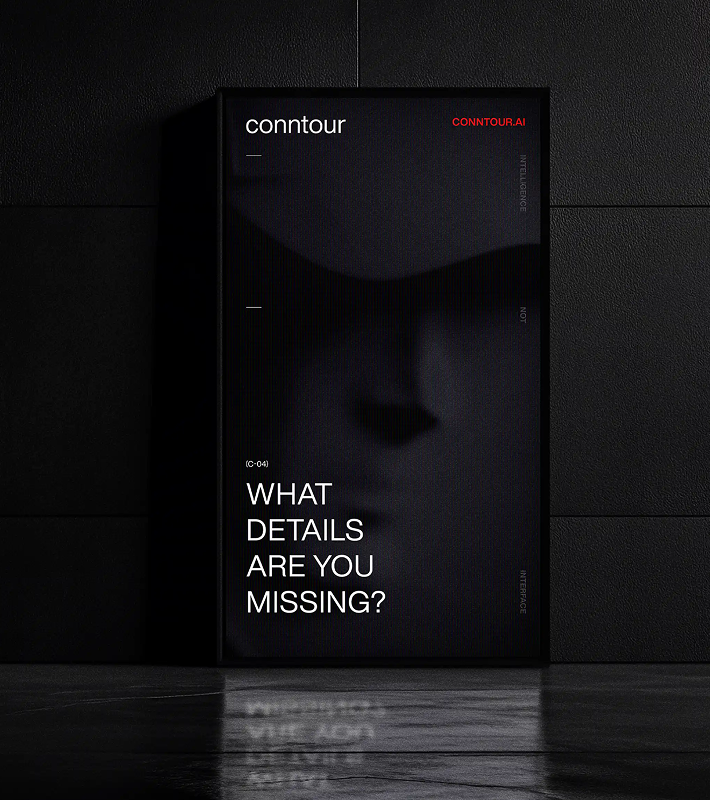
The founding team described the feeling they wanted in one phrase: think CIA, not IBM. Sophisticated, lethal, quiet. Every visual and verbal decision was pressure-tested against that instinct.
The startup's original soft blue was killed immediately. In its place: a near-total monochrome palette — deep blacks, cool greys, white — punctuated by a single, non-negotiable red used at surgical frequency. Red doesn't decorate. It identifies. It functions the way it functions in the product itself: isolating the target from the noise.
Typography reinforces the discipline. Helvetica Now — blunt, institutional, unshakeable at scale — rejects the geometric sans-serifs flooding the defense-tech category. No bespoke letterforms, no performative futurism. Paired with a strict grid system, even the most expressive layouts maintain the rigour of an intelligence dossier.
The imagery system is where the identity earns its distinction. CAPRI developed a proprietary visual language called "The 3 Layers of Conntour" — abstract, tactile forms emerging from darkness, stripped to bare contour lines, then revealed through a red wireframe overlay at the moment of identification. The progression mirrors the product's own logic: ask, detect, see. It's a visual interrogation — the image yields its subject the way footage yields evidence under the right question.
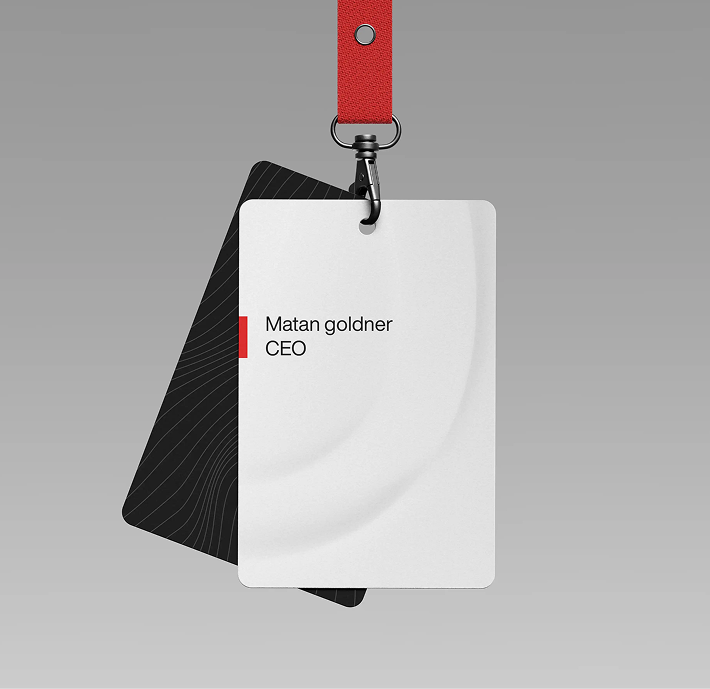
The verbal architecture follows an Ask → See → Act framework, giving sales teams a messaging spine that holds under pressure whether the audience is a Singapore narcotics bureau or a Fortune 500 loss-prevention team. Tone was calibrated to command without intimidating. Graphic devices — red accent bars, catalogue-style reference codes, macro/micro text pairings — give every touchpoint the cadence of an operational brief.



Before the rebrand, Conntour's team spent the first half of every prospect meeting establishing credibility. After launch, the brand did that work before the call began.
The new identity deployed across active government engagements in Singapore, the United States, and the Middle East. Bob Flores, former CTO of the CIA, went public with his assessment: the real challenge was never a lack of video — it was extracting what matters. Conntour, he said, makes that possible. When a former CIA chief volunteers that endorsement unprompted, the interrogation is over. The brand got the confession it needed.